

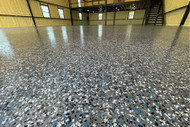
Most garage floor coatings that fail were not bad products. They went down on a slab nobody measured properly and nobody tested. The number that decides whether your floor holds is not on the bucket at all. It is the moisture limit in the manufacturer's own instructions, and those vary a lot. Across the manufacturer documents we checked, the stated limits ran from about 3 to 20 lb per 1,000 sq. ft. per 24 hours.
Measure the space properly
Garage labels lie. A "two-car garage" can come in under 400 sq. ft. or over 500 once you count the alcove, the step, the stem wall, and the bay where the shelving lives. Measure each rectangle on its own. Subtract only the permanent stuff that will never get coated.
Then add material allowance. Twelve percent is a sensible planning number, though it is not a rule. Run it and the picture changes: 400 sq. ft. becomes 448, 450 becomes 504, and 500 becomes 560. That is usually the moment people realise a kit rated for a range sits comfortably at one end of it and very tight at the other.
Check the slab before choosing chemistry
No ASTM standard sets a pass or fail number for moisture. ASTM F1869 measures vapour emission with anhydrous calcium chloride. ASTM F2170 measures relative humidity inside the slab using probes. ASTM F710 then sends you to the manufacturer's written instructions for the number you have to hit. Any figure quoted to you as "the ASTM limit" is really a product limit wearing a standards badge.
So the order matters. Pick the system, find its stated moisture ceiling, then test against that. While you are down there, check for old sealers, which can stop the coating bonding, and confirm your slab and air temperatures sit inside the product's application window. Polyaspartic does very well on a sound, dry, properly profiled slab. On a slab with an untreated moisture problem it will fail, and no topcoat added later will rescue it.
Choose a system build, not just a product
How much flake you want changes the build itself. ArmorPoxy publishes its Medium Broadcast kit as a two-layer system, four gallons of coating plus medium flake. The Full Broadcast kits are three layers, basecoat then flakes then topcoat, and come in 400 and 800 sq. ft.
Heavier flake hides trowel marks and old patches and gives you more grip underfoot. Lighter or solid colour shows more of the slab, including any repair you made. Decide that before ordering, because it sets both the flake quantity and the kit size.
Coverage and budget math
Coverage figures come with conditions attached. ArmorPoxy publishes 300 to 500 sq. ft. for the Medium Broadcast kit depending on surface porosity and application method. A porous, open slab drinks material. A tight steel-troweled one does not. Hold your adjusted number against the bottom of that range, not the top, and if it lands past 500 look at the larger kit rather than stretching the smaller one.
Then budget for what the kit does not contain: grinder or shot-blast rental, dust control, crack and spall repair, tools, safety gear, delivery, and tax. These are what usually separate a plan from a finished floor.
Working time and return to service
Polyaspartic moves fast. ArmorPoxy publishes 10 to 15 minutes of working time for the Medium Broadcast kit, and that clock covers mixing, pouring, cutting in the edges, rolling, keeping a wet edge, and broadcasting flake.
Plan your batches before you open anything. Chalk the section lines on the slab, stage every tool and bag of flake where you will actually need it, and put one person on mixing while the other applies. ArmorPoxy publishes 2 to 4 hours to touch and recoat, then 24 to 48 hours before you park on it. Those clocks start when you finish applying, not when you start the day.
Before you order
Get six things straight in writing: your measured area with allowance, the coverage of each component, your slab's moisture reading against the product's stated limit, the application temperature window, the recoat window, and the vehicle cure time. If you would rather not do the measurement and coverage math by hand, our free 400 to 500 sq. ft. project planner walks you through it.